







Use AI to summarize this article




Your SaaS product might be excellent. Your design might look sharp and modern. But if the copy on your website does not speak directly to what your buyers care about, none of it matters. Visitors leave without booking a demo. Traffic stays flat. Inbound does not grow.
This is the most common pattern we see when B2B SaaS and AI companies come to Flowtrix for a website revamp. It is rarely a design problem. It is almost always a messaging problem. The copy is unclear, generic, or aimed at the wrong person at the wrong stage of the journey.
Good website copywriting is not about being clever. It is about being precise. It is about making the right person feel like you are speaking directly to them the moment they land on your page. This guide covers the core messaging frameworks that work for B2B SaaS website copywriting, where to use them, how they fit together, and the common mistakes that cause good SaaS websites to leak pipeline every single day.
Why Most B2B SaaS Website Copy Does Not Convert
Most B2B SaaS websites have a copy problem that looks like a traffic problem. They blame the channel. They test new ads. They try new landing page templates. But the issue is on the page itself, not in the source of the traffic.
Here is what bad B2B website copy looks like in practice. The hero headline leads with features instead of outcomes. The value proposition is vague, something like "the all-in-one platform for teams." The copy tries to speak to everyone, so it resonates with no one. There is no clear answer to the most important question your buyer is asking, which is: why should I care about this right now?
The fix is not a better design. It is better messaging. And better messaging comes from choosing the right framework and applying it with discipline across every page on your site.
What Good B2B SaaS Website Copywriting Actually Does
Before getting into the frameworks, it helps to understand what website copywriting is actually trying to accomplish in a B2B context.
B2B buyers are not impulse buyers. They are evaluating multiple tools. They are talking to colleagues. They are looking for reasons to trust you, reasons to believe your product delivers what it promises, and reasons to feel confident recommending you internally. Your website copy needs to do all of this at once, for multiple stakeholders, across multiple pages, in a way that feels natural and not salesy.
That is a lot to ask. The frameworks below are what make it possible to do this consistently, without guessing every time you write a new page or redesign a section.
B2B buyers visit your site an average of 3 to 5 times before filling out a form. Every page they visit needs to reinforce the same core message. Inconsistent messaging across your site creates doubt, and doubt kills conversions.
Framework 1: Problem, Agitation, Solution (PAS)
PAS is one of the most reliable structures in website copywriting. It works because it mirrors the way your buyer already thinks about their situation. It does not try to convince anyone of anything. It simply names the problem, makes the stakes of that problem feel real, and then positions your solution as the logical answer.
Problem: Name the pain clearly and specifically. "Your website gets traffic but not enough demo bookings." Use the exact language your buyers use when they describe the problem themselves.
Agitation: Make the problem feel urgent. "Every week that passes, qualified visitors leave without converting. Your sales team closes deals through referrals, not inbound." Show what inaction costs.
Solution: Present your product or service as the clear, logical answer. Keep it specific and outcome-led. Do not describe what you do. Describe what changes for the buyer after they work with you.
Where to use PAS: Homepage hero sections, ICP-specific solution pages, high-intent paid landing pages, and any page where you know the visitor's primary pain point before they arrive.
The mistake most SaaS companies make is rushing to the solution before the buyer feels understood. Spend more time on the problem and agitation. When a visitor reads your page and thinks "this is exactly what we are dealing with," they are already halfway converted. The solution section does not need to be long. The first two sections do the heavy lifting.
"The enemy of great copy is vagueness. Every B2B SaaS website claims to increase productivity or streamline workflows. These statements are so generic they become meaningless. Make bold, specific claims that are unique to your product."
Framework 2: Jobs to Be Done (JTBD) Messaging
Jobs to Be Done is a framework rooted in customer research. The core idea is that people do not buy products. They hire them to do a job. When you write copy around the job your product performs, it becomes more specific, more human, and more persuasive because it matches the exact mental model your buyer already has.
The JTBD copywriting template:
Use this structure to build messaging for any page: "When I am [situation], help me [job], so I can [desired outcome]."
Applied to a B2B SaaS website revamp context: "When I am scaling from Series A to Series B and our website no longer reflects where the product is, help me revamp the site quickly and with precision, so I can align our web presence with our sales process and close more enterprise deals."
JTBD copy shifts the focus from what your product is to why the buyer needs it right now, in their specific situation. It answers three unspoken questions at once: is this for me, does this solve my actual problem, and will this get me to where I need to go?
JTBD messaging works best on product pages, use case pages, and persona-specific landing pages. It is also very useful for writing homepage subheadings that sit below your main hero statement. The hero grabs attention with PAS or BAB. The subheadings then filter visitors by situation and role, helping the right person self-identify immediately.
Framework 3: Before, After, Bridge (BAB)
BAB works by creating a contrast between where the buyer is now and where they could be. It is one of the most effective frameworks for homepage hero sections and case study pages because it uses the power of imagination. You do not have to prove everything. You just have to make the after feel real and achievable.
Before: "Your website was built two years ago. It does not reflect your current product, ICP, or positioning. Inbound is flat. Your sales team avoids sending prospects to it."
After: "Imagine a site that your sales team loves sending prospects to. A site that explains your product clearly, builds trust fast, and drives demo requests consistently without you touching it."
Bridge: "That is what a CRO-focused Webflow revamp delivers. Strategy, design, build, and SEO in one focused process. No guesswork. No agencies passing the project around."
BAB is particularly powerful for companies selling a transformation rather than just a feature. It helps buyers visualize the outcome before they have to commit to anything. This reduces hesitation and makes the CTA feel like a natural next step instead of a risk.
Framework 4: The Value Proposition Canvas in Copy
The Value Proposition Canvas is usually a product strategy tool. But it is one of the most useful frameworks for structuring website copy because it forces you to map your messaging to real customer needs instead of internal assumptions.
The canvas has two sides. On the customer side: what the buyer is trying to do, the pains they face, and the gains they want. On the product side: your features, the pain relievers, and the gain creators. Your copy should live in the intersection of those two sides.
Customer pain: Dev-dependent website updates slow down campaigns. Weak copy lists technical CMS features. Strong copy tells marketers they can publish pages without opening a Jira ticket.
Customer job: Launch campaigns without waiting on engineers. Weak copy says "easy to use" with no proof. Strong copy shows the workflow: design it, publish it, done.
Desired gain: Full control over website velocity. Weak copy focuses on platform capabilities. Strong copy shows campaigns going live when marketing needs them, not three weeks later.
Buyer fear: What if migration breaks SEO? Weak copy ignores the objection entirely. Strong copy addresses it directly: SEO-safe migration with 301 redirects managed end to end.
Where Each Framework Belongs on Your Site
Choosing a framework is only half the job. Knowing where to deploy it is the other half. Different pages serve different purposes in the buyer journey. Your copy needs to match where the visitor is in their thinking, not just what you want to say.
Homepage:
Use PAS or BAB for the hero section. Your headline should name the specific outcome you deliver, not describe your product category. The goal is to make someone think "this is for me" within five seconds of landing. Subheadings can then use JTBD language to speak to specific buyer roles or situations. Every section should answer one question and lead to the next.
Solutions and Use Case Pages:
JTBD is the strongest framework here because these pages are read by buyers who already understand the category. They need specificity. They want to know how your product helps someone in their exact role, their exact industry, or their exact growth stage. Generic copy on use case pages is one of the biggest conversion killers we see at Flowtrix.
Pricing Page:
This is where the Value Proposition Canvas matters most. At the pricing stage, your buyer is comparing you to alternatives. Your copy needs to reinforce what makes your product worth the investment. Be specific about what each tier includes and what outcome it produces. Do not just list features. Show what changes at each level.
Paid Landing Pages:
PAS is the strongest framework here. The visitor arrived because of a specific search or ad. Your headline should mirror that intent exactly. The rest of the page should agitate and solve that one problem in a focused, distraction-free way. One goal. One CTA. Nothing else.
At Flowtrix, we build messaging maps before writing a single word of copy. We define the primary ICP for each page, their top three pains, the outcome they want, and the one objection most likely to stop them from clicking. Every section on the page traces back to that map.
The Role of Buyer-Specific Messaging
One of the biggest mistakes in B2B SaaS website copywriting is writing for everyone. When you write for everyone, you convert no one. This sounds obvious, but most SaaS websites still do it. The homepage speaks to founders and CMOs and developers all in the same paragraph. No one feels like the page is really for them.
B2B buying decisions involve multiple stakeholders. A Head of Marketing cares about speed to market and inbound pipeline. A VP of Engineering cares about tech stack and maintainability. A CFO cares about ROI and risk. Each of these people needs to find something specific on your website that speaks to them.
The solution is not to write ten different sites. It is to structure your pages so the primary ICP sees themselves immediately in the hero section, while secondary stakeholders can find what they need further down the page or in dedicated sections.
Head of Marketing: Primary concern is inbound pipeline and campaign velocity. The copy angle that works is demo bookings up with no more waiting on dev for page changes. Best pages are the homepage and solutions pages.
CMO / VP Marketing: Primary concern is brand perception and enterprise positioning. The copy angle that works is a site that reflects product maturity and supports closing bigger deals. Best pages are the homepage, about, and case studies.
Founder / CEO: Primary concern is speed, ROI, and no surprises. The copy angle that works is faster time to results with a proven process and clear outcome at every stage. Best pages are the homepage, pricing, and case studies.
Demand Gen Lead: Primary concern is conversion rates and landing page quality. The copy angle that works is landing pages that convert paid traffic without relying on dev. Best pages are the CRO page and landing page work.
Messaging Consistency Across the Whole Site
One well-written homepage does not make a converting website. The framework you choose needs to carry through every page in a consistent way. This is where most SaaS companies fall short. The homepage is strong. The product pages feel generic. The case studies use different language. The pricing page reads like a features list. When messaging feels inconsistent, it creates doubt, and doubt kills conversions.
B2B buyers visit your site multiple times before they fill out a form. They read a blog post. They come back to check the pricing. They send a colleague to look at the product page. Every touchpoint needs to reinforce the same core message, the same outcome, the same proof that you understand their problem deeply.
Build a messaging document first. Before writing a word of copy, document the following. Define your primary ICP and the specific situation they are in when they arrive at your site. Write out their top three pains in their own language, not yours. Define the three outcomes your product delivers, with specifics not generics. List your top three differentiators and the proof behind each one. Identify the one objection most likely to prevent a click and address it on every page. Make every writer, designer, and developer align to this document before touching the site.
A messaging document is what keeps your site consistent at scale. Every new page, every new section, every new CTA traces back to it. Without it, you end up with a site that says ten different things and convinces no one of anything.
If you are migrating from WordPress or HubSpot to Webflow as part of a revamp, read our Drupal to Webflow Migration Guide for 2026 to understand how to keep your SEO and messaging intact during the move.
What Good Website Copywriting Services Actually Deliver
There is a meaningful difference between writing copy and delivering website copywriting services that produce pipeline. The difference comes down to research, strategy, and integration with design.
Good website copywriting services start with customer discovery. They interview real buyers, review sales calls, and dig into the language your customers actually use when they describe their problems. They do not guess. They mine for exact words and phrases that already resonate with your audience. This is the single most important input to great copy, and most in-house teams skip it because it takes time.
Then they build a messaging framework before writing a single word. They define the positioning, the ICP hierarchy, the key outcomes, the proof points, and the objections to address. This is strategy work, not writing work. The writing comes after.
Finally, they integrate copy with design and page structure. A great headline in the wrong position on the page will not convert. Good website copywriting services work closely with the design team to make sure every word appears in the right place, in the right size, at the right moment as the visitor scrolls.
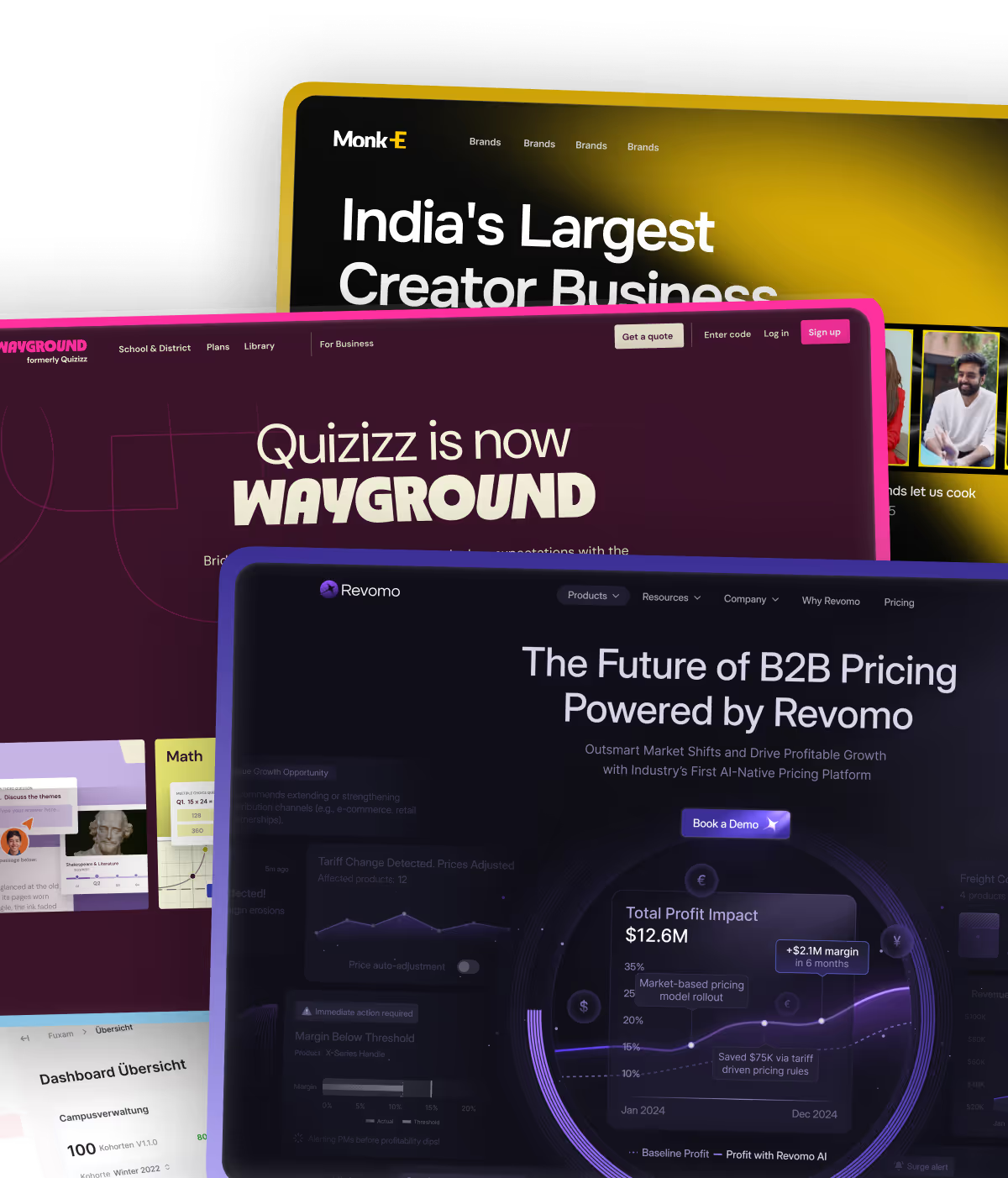
At Flowtrix, we bundle messaging strategy and copy direction into every website revamp. We work with B2B SaaS and AI companies from Series A to Series C, combining strategy, CRO-focused design, Webflow build, and SEO into one process. Companies like Databahn, Akirolabs, Fuxam, and Wayground have gone through this and come out with sites that actually drive inbound.
Common Mistakes That Kill B2B SaaS Copy
Leading with your company instead of the customer's problem:
"We are a leading AI platform" does not tell the buyer what they get. Lead with the outcome the buyer wants, not a description of who you are. Your company description belongs on the About page, not the homepage hero.
Using jargon that only insiders understand:
If a VP Marketing at a 50-person SaaS company cannot read your homepage in 10 seconds and understand what you do and who it is for, the copy is not clear enough. Read every sentence out loud. Remove anything that sounds like a press release. If you would not say it in a conversation, do not put it on your website.
Writing the same copy for different ICPs:
If you sell to cybersecurity companies and to SaaS startups, these audiences have completely different pains, different vocabulary, and different expectations. Generic copy will not work for either. Segment your messaging by page or by section within the page.
Weak or missing CTAs:
Every page should have one clear action you want the visitor to take. That CTA should appear early, be specific, and repeat at logical points as the visitor scrolls. "Learn More" is not a CTA. "Book a 25-minute strategy call" is a CTA. The difference in conversion rate between these two approaches is not small.
Ignoring the objection layer:
Great copy does not just make the case for your product. It also addresses the reasons someone might not click. Price, risk, complexity, time to value, internal politics. If you know what your buyers worry about before they commit, address those concerns directly in the copy. Silence on key objections reads as avoidance.
Count how many times your homepage says "we," "our," or the company name versus how many times it says "you" or "your." If the ratio is lopsided toward "we," rewrite it. The buyer should be the hero of the page, not your company.
Final Thoughts: Copy Is the Foundation, Not the Finish Line
The best website designs in the world will not save weak copy. And the best copy will not save a website with poor structure and a confusing user experience. The two have to work together from the start, built around a clear messaging framework that every person on the project understands.
If your website is not converting the way it should, the answer is almost never to add more features to the page or run more ads to it. Start with your messaging. Ask whether your ideal buyer can read your homepage and immediately understand what you do, who it is for, and why they should care right now. If the answer is no, that is where to focus first.
At Flowtrix, we help B2B SaaS and AI companies turn their website into a predictable inbound and demo booking engine. We are a certified Webflow Enterprise Partner, nominated for Webflow Partner of the Year 2025, and have delivered 120+ projects globally for companies across the US, UK, Europe, and the Middle East. If your site is getting traffic but not converting, or if your messaging no longer reflects your product and ICP, book a call with our team and let us show you what a foc




.avif)





.svg)
.svg)

